Celebrating 25 years – After the final flight
When the last remaining QantasLink Boeing 717 touched down for the final time in December 2024, it closed the book on more than two decades of service in Australian skies. But for one aircraft, the story was far from over.
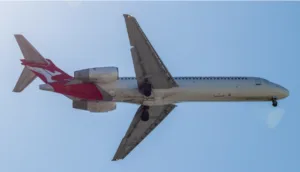
For David Kingshott, Qantas Group Engineering Academy Technical Lead and Aviation Australia’s Practical Training Manager, the farewell was personal. He was on board for the B717’s final official passenger flight, surrounded by memories of the people who had flown, maintained and operated it and the extraordinary distances it had travelled.
“It was strange looking out the window, counting how many hours it had flown in its life. I worked out it flew the equivalent of 22 round trips to the moon,” Kingshott recalls.
“My wife used to fly the aircraft, and a lot of my good mates have flown it.
“On the day of the ferry flight from Canberra to Brisbane, a big crowd gathered to watch the last flight of a B717 in Australian skies. Watching the aircraft land for the last time and the crew all waving to the crowd, many emotions flowed.”
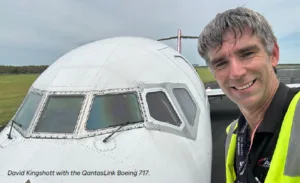
But while its flying days were over, the aircraft’s working life wasn’t.
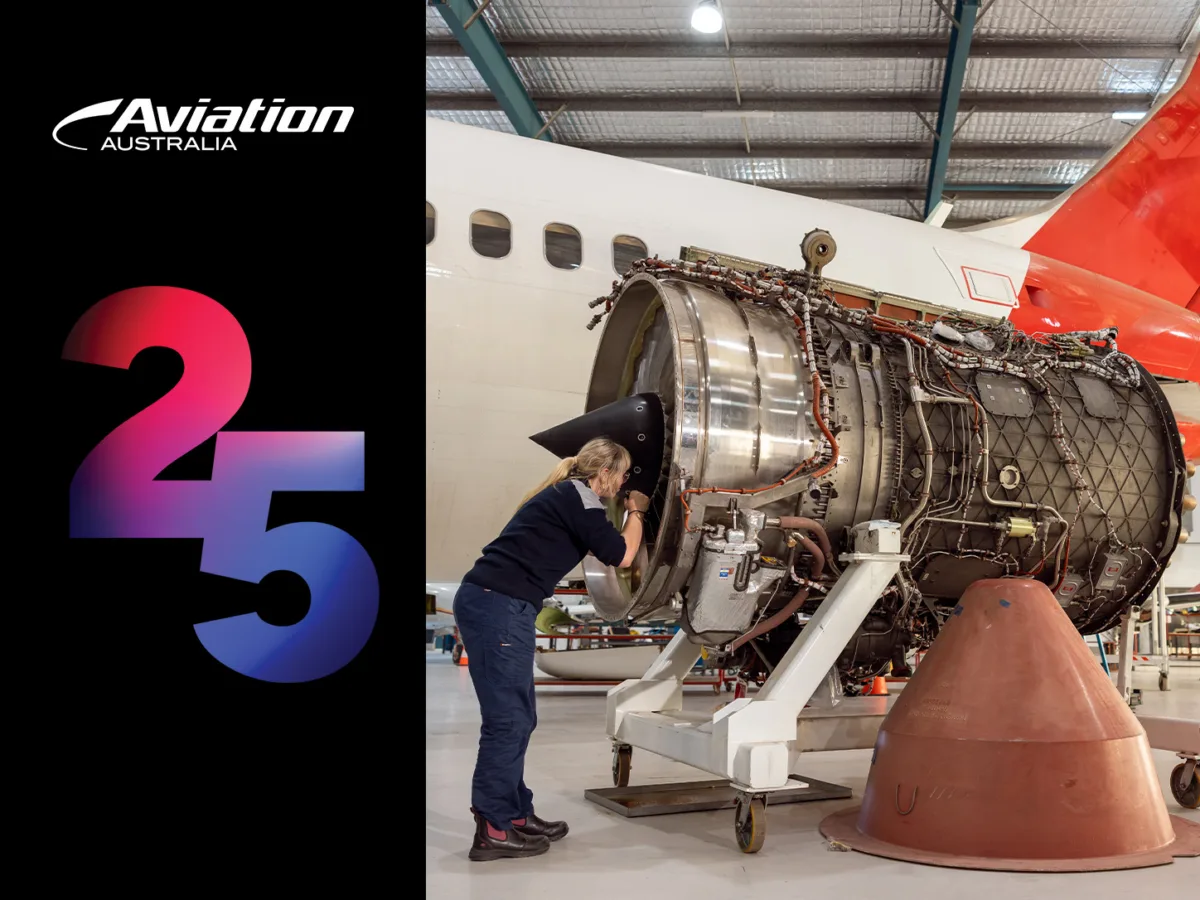
Rather than being retired for good, the B717 was donated to Aviation Australia, where it has found a second life at the Qantas Group Engineering Academy, helping train the new guard of aviation engineers.
“Knowing that Aviation Australia and Qantas will be able to keep that history alive is really important,” Kingshott says.
“It may not be flying anymore, but it’s still working for a living, training the next generation of engineers.”
Established in response to the needs of an ageing aviation workforce, the Qantas Group Engineering Academy is now in its second year, preparing the next generation of engineers and building a pipeline of industry-ready apprentices for Qantas.
At its permanent home in the Qantas Academy hangar, the B717 gives students something no textbook or simulation can replicate: the chance to learn on a real aircraft.
For Kingshott, that hands-on experience is fundamental to becoming a capable engineer, particularly when developing one of the profession’s most important skills: fault-finding.
“Fault-finding, or what we call test and troubleshooting, is really the key to building a good engineer,” he says.
“To be a good troubleshooter, you have to understand the system that it operates off.”
Modern aircraft have sophisticated systems designed to identify faults quickly and efficiently. But Kingshott believes good engineers still need to understand what is happening beneath the technology, rather than simply relying on it for the answer.
“Aeroplanes these days use a fault isolation manual. The best way to explain it is like a car: you take it to a mechanic, they plug it into a computer, it gives them a fault code and tells them what sensor to change,” he says.
“It makes it more economical for airlines and keeps aeroplanes flying, but it can reduce how much problem-solving is required from the engineer.
“And sometimes it’s wrong, the issue isn’t covered or the manual simply doesn’t go far enough.
“That’s what we’re training them to do. Yes, they know how to use the fault isolation manual, but they also know how to work it out themselves: the process of fault diagnostics and rectification.”
It is also why the Academy deliberately exposes students to a range of aircraft, rather than training them solely on the technology they are most likely to encounter in their careers.
Alongside the B717, students work on a King Air C90, Piper PA-31 Navajo and McDonnell Douglas MD-82, learning across different generations of aircraft, systems and technology.
For Kingshott, whose own career in historic aviation has included maintaining aircraft dating back to the 1930s, that breadth of experience matters.
“The real bonus of the Academy is that it gives students a holistic view,” Kingshott says.
“Nobody knows where their career is going to take them, so we want to give them that breadth of knowledge from the beginning.”
The Academy is part of a much larger engineering training ecosystem at Aviation Australia, with more than 800 domestic and international apprentices currently enrolled across mechanical and avionics streams.
For Mechanical Instructor Elio Ferri, who began his own apprenticeship in 1982 and has spent the past 15 years training students at Aviation Australia, both disciplines ultimately come back to the same thing: safety.
“We are talking about aeroplanes sometimes carrying a few hundred passengers,” he says.
“One mistake could result in the loss of an aircraft, and that could mean a lot of lives being lost.”
That responsibility shapes the way students are trained.
Across Aviation Australia’s mechanical engineering courses, theoretical learning is reinforced by practical experience. Students handle tools, interpret maintenance manuals, follow procedures and physically work through tasks on aircraft. They learn what a particular torque feels like in their hands, how to complete a task when they cannot easily see what they are working on and how to turn written instructions into precise actions.
“They learn the difficulties they’re going to face when they can’t see something and still have to do it. They get to learn the ins and outs,” says Gordon Brown, Aviation Australia’s Manager of Curriculum Design and Development.
“We can also program faults into the aircraft so students have to diagnose what’s wrong and work out how to fix it.”
For Brown, the training environment has transformed significantly since he joined Aviation Australia 12 years ago. Where much of the courseware was once delivered through Word documents and PowerPoint presentations, today’s students learn in modern classrooms and online using web-based HTML content, lightboards, simulated environments and increasingly sophisticated technology.
Ferri tells a similar story.
“If we were trying to show how a hydraulic system operates, it’s hard to see when you’ve just got an image. But nowadays, with our development team, we’re able to create our own animations and can actually 3D print whole engines and their sections so students can see the internal workings,” he says.
“We now have all these training aids that have really made it easier for students to grasp the theory behind these concepts.”
As technology continues to advance, the role of the engineer will evolve with it.
Kingshott believes future engineers may need to work comfortably across both mechanical and avionics disciplines, as increasingly interconnected aircraft systems blur the boundaries between the two.
“The future is exciting,” he says. “Even in my 30-something years in the industry, it’s changed so, so much. In 10 years’ time, the way we look at aviation will be different again.”
Exactly where that technology will take the industry is impossible to predict, but Brown believes quality human oversight and accountability will remain fundamental.
“The quality sign-offs for licensed aircraft maintenance engineers still need to be the confirmation that they’re happy with any maintenance that has been completed on an aircraft,” he says.
For Aviation Australia, which has been training aircraft engineers throughout its 25-year history, the challenge is to prepare students for what comes next without losing the fundamentals that have always underpinned the profession.
And for Kingshott, Brown and Ferri, that means passing decades of experience on to the people who will take aviation into its next chapter.
“The main thing for me is developing and inspiring the next generation to believe in themselves, believe in their dreams and give them the best opportunities possible to achieve that,” Kingshott says.
“The course is not easy. They’re going to stumble. They’re going to fall. But the reward is huge.”
Perhaps there’s no better symbol of that than the B717 sitting in the hangar. Its final flight may be behind it, but its contribution to Australian aviation is far from finished.